What Actually Makes an Object "Collectible"?
By VETRIS Atelier
Collectible Handmade Objects: How to Choose Well
What Actually Makes an Object "Collectible"?
There are moments when you walk into a room and your eye stops on a single object. Usually it isn't the size or the price that holds your attention it's a difference you notice in the surface, the texture, the way it catches light. That's exactly what we mean by a collectible handmade object: not the repeating perfection of mass production, but a surface that carries the trace of one hand, one kiln, one particular moment.
That difference isn't always easy to see with the eye alone. Especially with a craft as technically deep as vitreous jewelry enamel, understanding what's actually behind the label "handmade" is both a matter of trust and a long-term investment decision for the buyer. In this piece, we walk through what to look for when choosing a collectible object: how to read material quality, genuine craft marks, and real handwork.
Material: What's Beneath the Surface?
The first thing that determines an object's collectible value is the material itself. In VETRIS's Istanbul atelier, every artifact is built on a 100% pure copper surface. Copper conducts heat well and, over time, develops its own distinctive patina not a flaw, but a sign that the object is alive and genuine.
What's applied onto that copper surface is a separate story: vitreous jewelry enamel. It's a specialized mixture of ground glass, metal oxide pigments, and fluxing agents, applied to the metal surface and then fired at 750–900°C until it vitrifies. At that temperature, the glass powder melts and forms a chemical bond with the copper, producing once cooled a permanent, hard surface that reflects light with real depth. This is a result no paint or printing technique can replicate, because the colour doesn't sit on the surface it lives inside the material itself.
There's an important distinction for collectors here: vitreous jewelry enamel is not the same thing as an industrial glass coating. That industrial glass coating the glossy surface you see on pots, sinks, or cast products is a spray-applied process built for mass production. With vitreous jewelry enamel, by contrast, every layer is applied, fired, and checked by hand a far more demanding and time-consuming technique specific to the jewelry trade.
Reading the Marks of Real Craft
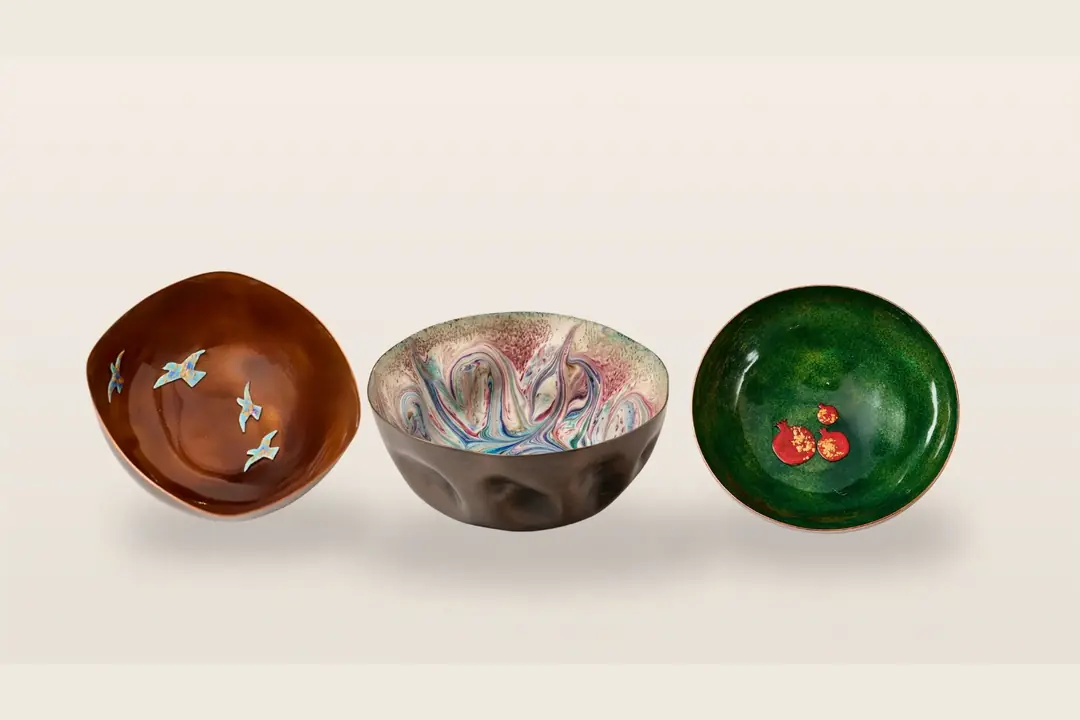
The biggest sign of genuine handwork isn't perfection it's the opposite: small variation. Tiny shifts in kiln temperature, the distribution of the glass powder, the humidity at the moment of application, the heat distribution inside the kiln, the speed of cooling all of it shapes the result. Two pieces made with the same colour mixture, by the same hand, in the same kiln, will still come out with different surface texture, different light reflection, different colour transitions. That's not a flaw it's the nature of vitreous jewelry enamel.
When choosing a collectible object, look for these variations: how organic the colour transitions feel, how light breaks across the surface, the subtle differences between two similar pieces. A decision made purely from a catalogue photo or a digital image can only ever be an approximation the piece that reaches your hands is a singular form, born in that moment, under those specific conditions.
One of the pattern techniques used in VETRIS's Craft Series, the Ebruli vitreous jewelry enamel pattern, is a clear example of this natural variation: inspired by Turkish ebru marbling art, colored vitreous jewelry enamel mixtures are moved across the surface before firing, and no two patterns ever repeat.
Longevity and Value
The most practical question to ask before investing in a collectible object is this: what will it look like decades from now? Because it's a vitrified surface, vitreous jewelry enamel doesn't fade or run the way paint does over time. With proper care simply wiping with a dry, soft cloth it holds its character for decades. The one thing to watch for is that the glass surface can crack under a hard impact; that's inherent to glass itself, so avoiding drops and hard knocks matters.
The copper body itself may oxidize and develop a natural patina over time. That doesn't mean the object has lost its function quite the opposite: it's how a collectible object deepens its character with age. Mass production can't replicate this kind of aging, because a surface coating is superficial by nature and simply wears or dulls over time.
A Perspective from the Istanbul Atelier
Vitreous jewelry enamel is a 3,000-year-old art, with the earliest known examples traced by archaeologists to the 13th century BCE. During the Byzantine era, workshops in Istanbul brought the technique to its peak; under the Ottomans, it became closely tied to jewelry-making, skillfully used in objects and jewelry made for the palace. Today, very few workshops in the world practice this technique in its true form VETRIS's Istanbul atelier aims to carry that long tradition forward in a language relevant to today's collectors.
Knowing where and how an atelier works is valuable information for a collector, too transparency of production, the origin of the material, how many hands a piece passes through these are all details that strengthen a purchase decision.
One Piece, or a Set?
When people think of a collectible object, a single piece usually comes to mind first, but sets conceived as a collection have their own logic in craft production. VETRIS's Trio and Quartet arrangements bring together pieces from the same pattern family, each of which has still gone through its own firing journey. Whether a single strong statement piece or a group that speaks to each other in scale and tone suits a console or a display shelf better depends on the scale of the space and where the object will live. For gifting, a set arrangement often tells a more complete story than a single piece.
Q&A
Q: Is vitreous jewelry enamel the same as an industrial kiln coating?
A: No. Both involve applying glass to metal, but vitreous jewelry enamel is applied by hand, layer by layer, using pigments specific to the jewelry trade, while an industrial kiln coating is a spray-applied mass-production process. There are clear differences in surface quality, colour depth, and durability.
Q: How do I know a handmade object is genuine?
A: The most reliable way is to look for small variations on the surface colour transitions and texture that are similar but never perfectly identical between two pieces. It also helps to check whether the maker shares concrete, verifiable information about materials and the production process.
Q: How long does a collectible object like this last?
A: With proper care, vitreous jewelry enamel holds its character for decades; the vitrified surface doesn't fade or run. The copper body may develop a natural patina over time, which deepens rather than diminishes the object's character.
Q: Which VETRIS collection is a good starting point?
A: For those drawn to the material story and the craft process, the Craft Series is a strong starting point; for a stronger showpiece, the Signature Series stands out. For seasonal gifting, the Rituals collection is worth a look too.
Closing
Choosing a collectible handmade object is less about finding the right price and more about asking the right questions: what's beneath this surface, where do these variations come from, what will this object look like in ten years? Every artifact made in our Istanbul atelier carries the answer to those questions.
Explore the Craft Series: vetris.art/craft-series Explore the Signature Series: vetris.art/signature-series Browse the Rituals collection: vetris.art/rituals